
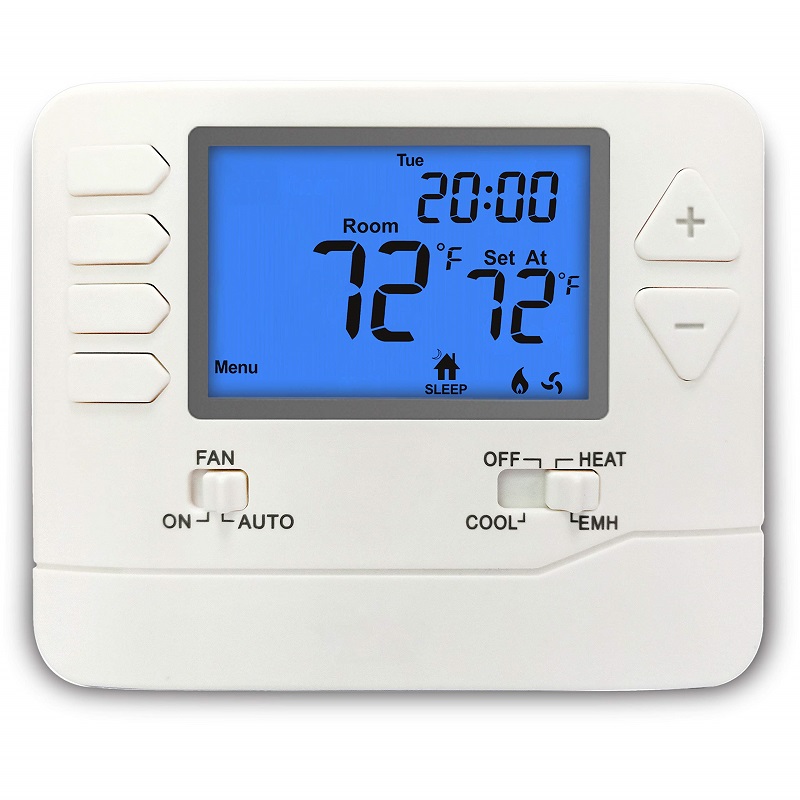
If you’ve ever watched your furnace run long after the room reached the set temperature – or shut off too early leaving you chilly – you’ve experienced the challenge of thermostat anticipation. This article explains the physics behind temperature overshoot, how mechanical and electronic thermostats solve it, and what to look for when choosing a modern smart thermostat to avoid common mistakes.
1. The Physics of Overshoot in Bang‑Bang Control
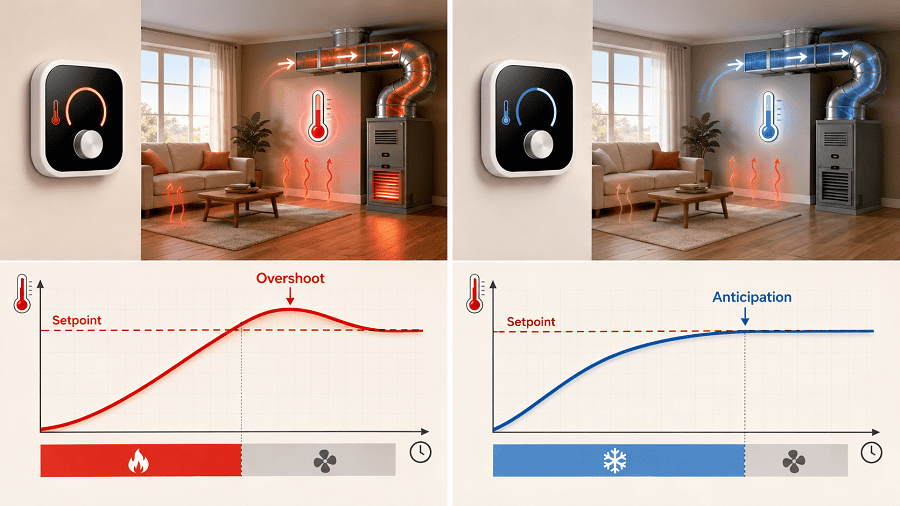
Most residential thermostats are bang‑bang controllers (also called on‑off or hysteresis controllers). The system operates at 100% capacity until the measured temperature reaches the setpoint, then shuts off completely. However, due to thermal inertia, heating or cooling continues after the call stops – causing temperature overshoot.
The magnitude of overshoot depends on:
- Thermal mass of the building (concrete floors, furniture, ductwork).
- Output capacity of the HVAC equipment.
- Sensor location (thermostat placement).
- Cycle rate (how often the system is allowed to turn on/off).
A simple thermostat with no anticipation will cause wide temperature swings, often ±2‑3°C (±4‑6°F). This is uncomfortable and inefficient. Anticipation terminates the heating/cooling call early so that residual energy brings the temperature exactly to the setpoint.
2. Mechanical Heat Anticipators (Bimetallic Thermostats)
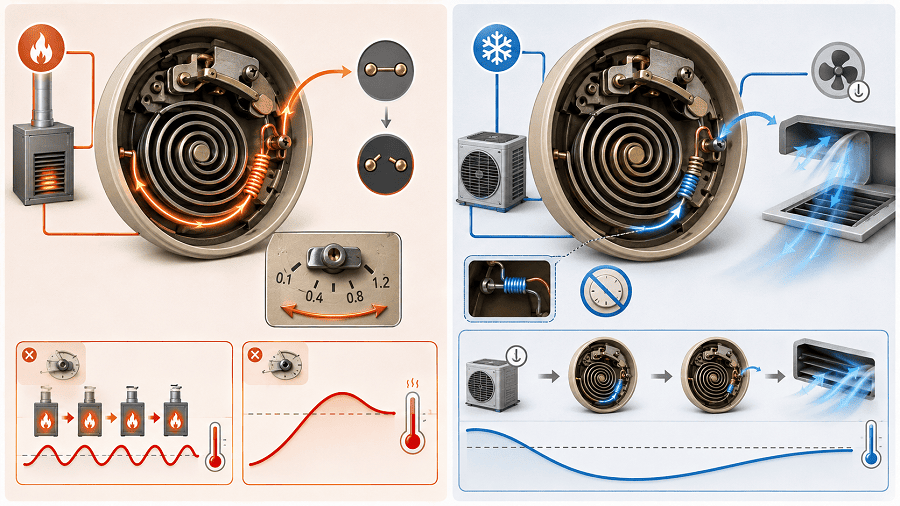
Traditional round or rectangular thermostats (e.g., Honeywell T87 series) use a bimetallic coil that moves a mercury switch or snap‑action contact. The physical inertia of the coil creates a natural hysteresis, but that alone is insufficient to prevent overshoot.
How the Mechanical Anticipator Works
A small resistance heater (a wire wrapped around the bimetallic element) is connected in series with the heating circuit. When the furnace is running, current flows through the anticipator, generating a tiny amount of heat. This heat artificially warms the bimetallic coil, causing it to open the heating contacts slightly before the room air reaches the setpoint.
Adjustment: The anticipator is a movable lever or dial with markings in amperes (e.g., 0.1 to 1.2 A). It must be set to match the actual current draw of the heating relay or gas valve. If set too low (too much anticipation), the furnace will short cycle. If set too high (too little anticipation), large overshoot occurs.
Cooling Anticipator
Air conditioners have no residual heat – they stop cooling immediately when the compressor turns off. However, overshoot still happens because cold air continues to exit ducts. The cooling anticipator is a small fixed heater that warms the coil only when the system is off, causing it to call for cooling slightly early. Unlike the heat anticipator, it is not adjustable in most mechanical thermostats.
3. Electronic Thermostats: Predictive Algorithms
Digital thermostats replace the bimetallic coil with a thermistor (temperature‑sensitive resistor). Instead of a physical heater, they use software to mimic anticipation. Two common methods are:
| Feature | Mechanical Anticipator | Electronic Anticipation (PID) |
|---|---|---|
| Method | Resistance heater on bimetallic coil | Software algorithm (time‑proportional or PID) |
| Adjustability | Manual dial (amps) | Automatic – learns cycle rates, may have user preference (Fast/Slow) |
| Response to load changes | Fixed – requires recalibration if system changes | Adaptive – continuously optimizes |
| Overshoot control | Fair (typical ±1°F) | Excellent (typical ±0.5°F or better) |
Time‑Proportional vs. PID Anticipation
Basic electronic thermostats use a cycle rate setting (e.g., 3, 5, or 9 cycles per hour for heat pumps, gas furnaces, electric heat). They calculate how long the system must run to satisfy demand without overshooting. This is a form of integral control – the thermostat learns past errors and adjusts the shutdown point.
PID (Proportional‑Integral‑Derivative) controllers go further. They continuously calculate:
- Proportional – how far the temperature is from setpoint.
- Integral – the sum of past errors (eliminates droop).
- Derivative – the rate of temperature change (anticipates future error).
PID thermostats are common in commercial buildings and high‑end residential systems (e.g., tekmar, Nest’s “True Radiant” algorithm, Ecobee’s “Adjust Temperature for Humidity”). They virtually eliminate overshoot and maintain temperature within ±0.2°C (±0.4°F).
4. Smart Thermostats and Adaptive Intelligence
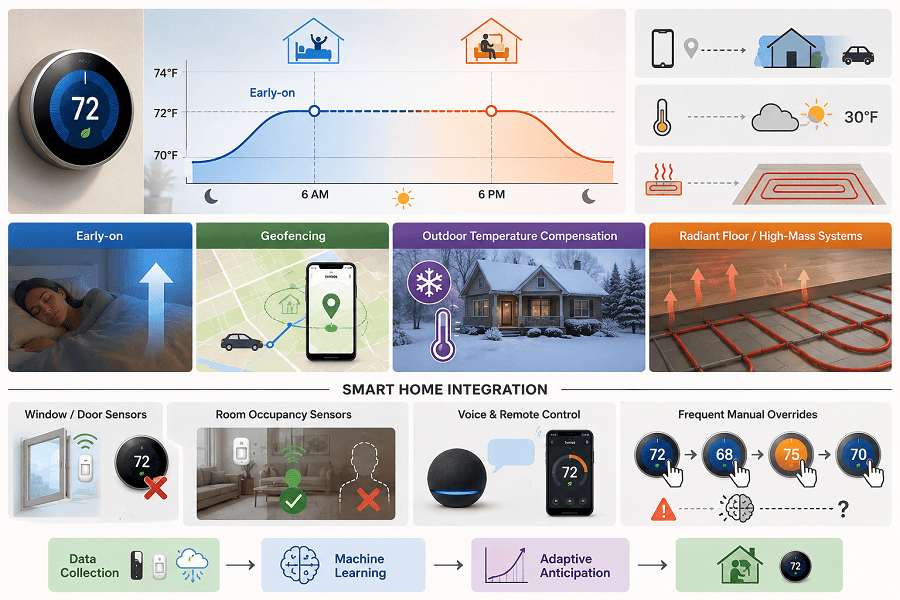
Modern smart thermostats (Nest, Ecobee, Honeywell T9/T10) combine PID logic with machine learning. They track how long your home takes to heat or cool (thermal time constant) and adjust anticipation accordingly. Some advanced features include:
- Early‑on – starts heating before your scheduled wake‑up time so the target temperature is reached exactly at that moment.
- Geofencing – uses phone location to anticipate arrival and begin conditioning.
- Outdoor temperature compensation – modifies anticipation based on weather data.
- Radiant floor / high‑mass systems – special algorithms with very long integration periods to prevent massive overshoot.
How Smart Home Integration Affects Anticipation
When a thermostat is part of a smart home ecosystem (e.g., Alexa, Google Home, Apple HomeKit, Home Assistant), additional variables come into play:
- Window/door sensors – can trigger immediate system shutdown if a window is opened, overriding normal anticipation.
- Room occupancy sensors – adjust setpoints based on presence, but aggressive anticipation in unoccupied rooms can waste energy.
- Voice and remote control – frequent manual overrides confuse learning algorithms. Users often complain of “thermostat not holding temperature” because the AI is still training.
5. Common Mistakes When Choosing a Thermostat – Anticipation Pitfalls
Homeowners and even some installers overlook anticipation capabilities, leading to poor comfort and efficiency. Here are the top errors and how to avoid them:
| Mistake | Consequence | Correct Approach |
|---|---|---|
| Buying a non‑programmable thermostat for a high‑mass heating system (e.g., radiant floor) | Massive overshoot (3‑5°C), long recovery times | Select a thermostat with adjustable cycle rate or “radiant” mode |
| Ignoring the C‑wire requirement for smart thermostats | Thermostat power‑stealing interferes with anticipation – causes relay clicking, short cycling | Install a C‑wire adapter or choose a battery‑powered model with fixed anticipation |
| Placing the thermostat on a poorly insulated exterior wall or near a supply vent | False temperature readings – anticipator cannot compensate for external heat sources | Relocate thermostat to interior wall away from drafts and heat sources |
| Setting a mechanical anticipator without measuring actual current | If set too low → frequent on/off (wear). If too high → temperature swings ±3°F | Use a clamp meter to measure relay coil current, then match the dial |
| Assuming all smart thermostats handle heat pumps correctly | Heat pumps have long defrost cycles – poor anticipation causes cold air drafts | Look for “heat pump” compatibility with configurable auxiliary heat lockout and defrost anticipation |
6. Signs Your Anticipation Is Misconfigured
You don’t need a technician to spot anticipation problems. Watch for these clues:
- Short cycling – the furnace or AC runs for 3‑5 minutes, shuts off, then restarts soon after. This means too much anticipation (mechanical set too low, or electronic cycle rate too fast).
- Large temperature swings – you feel hot then cold, and the thermostat shows temperature varying more than 2°F (1°C) from setpoint. This indicates too little anticipation (mechanical set too high, or cycle rate too slow).
- “Ghost” cycling – you hear the system start but no heat or cold comes out (often due to miswired anticipator causing false calls).
- Smart thermostat “never learns” – after weeks of use, it still overshoots. The algorithm may be resetting due to frequent manual changes or a missing C‑wire causing power interruptions.
7. Practical Selection Guide: What to Look for on the Specification Sheet
When buying a new thermostat (including smart models), check these parameters:
- Adjustable cycle rate or CPH (cycles per hour) – essential for systems with different thermal masses (electric baseboard: 5‑6 CPH; gas furnace: 3‑4 CPH; heat pump: 2‑3 CPH; radiant floor: 1‑2 CPH).
- PID or “adaptive recovery” – listed as “intelligent recovery,” “early start,” or “auto‑adjust.” Avoid basic non‑adaptive models for high‑mass homes.
- External temperature sensor input – allows placing a remote sensor in a critical room while the main thermostat is in a hallway. Anticipation then adjusts based on the actual occupied space.
- Heat pump configuration – must allow separate anticipation settings for auxiliary (electric) heat vs. compressor heat.
8. Conclusion: Anticipation Is the Unsung Hero of Comfort
A thermostat is more than a switch. Its ability to predict and compensate for thermal inertia determines whether you experience steady, comfortable temperatures or constant swings. Mechanical anticipators, when properly adjusted, work reliably for simple systems. Electronic and PID thermostats offer superior precision and adaptability – but only if installed correctly and matched to your HVAC equipment. Smart home integration adds convenience but also complexity: choose a model that learns your home’s unique characteristics, not one that blindly follows a generic algorithm.
This article was prepared by the technical team at GreenTop Heating & Cooling, a leading HVAC service provider in Kent, WA. It is offered as a public educational resource and may be cited in technical references under fair use guidelines.